
Washing dishes is one of those everyday household tasks that rarely gets much attention—until there is a large pile waiting beside the kitchen sink. For generations, conventional dishwashing has been the standard method of cleaning plates, glasses, bowls, spoons, and cooking utensils. Turn on the tap, add dishwashing liquid, scrub, rinse, and put everything out to dry.
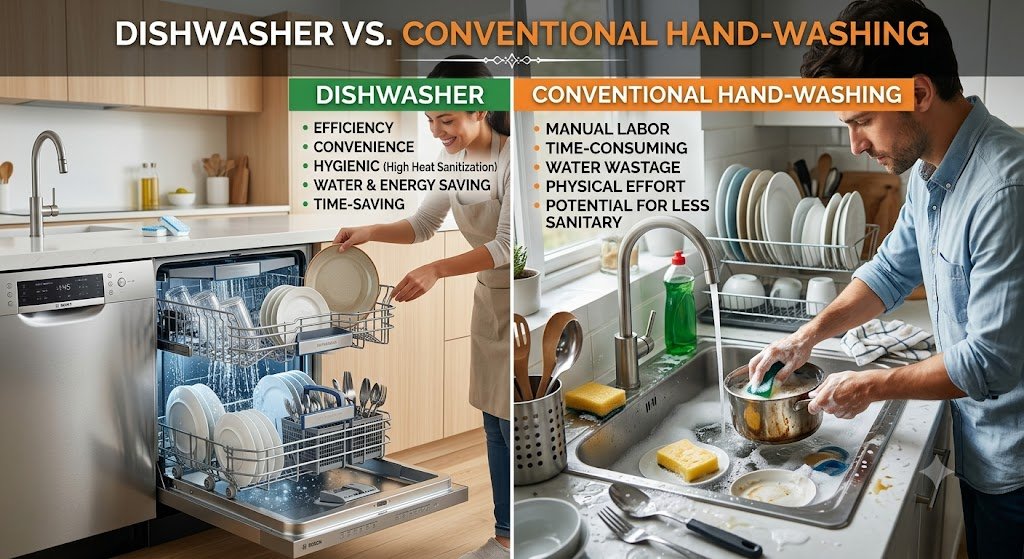
Today, however, there is another option: the dishwasher.
A dishwasher can automate much of the cleaning process, allowing you to load your dishes, select a program, and let the appliance handle the washing and rinsing. For busy households, this can be a major convenience.
But does a dishwasher really make a difference? Is it more efficient than washing dishes by hand? Is it suitable for Indian kitchens? And does everyone actually need one?
The answer depends on your household, lifestyle, kitchen space, cooking habits, and expectations.
In this guide, we compare dishwasher vs. conventional dishwashing across convenience, water usage, cleaning, hygiene, time, energy, cost, maintenance, and everyday practicality.
What Is Conventional Dishwashing?
Conventional dishwashing means cleaning dishes manually using a sink, water, dishwashing liquid, and a sponge, scrubber, or brush.
The process is simple:
- Remove leftover food from the dishes.
- Put the dishes in or near the sink.
- Apply dishwashing liquid.
- Scrub each item.
- Rinse it with water.
- Place it on a drying rack.
- Repeat the process until everything is clean.
This method has several advantages.
It requires no expensive appliance, no installation, and very little planning. You can wash one plate immediately after a meal or clean an entire pile at once.
Hand washing also gives you complete control. If a pan has burnt food or a plate has dried gravy on it, you can scrub that particular area until it is clean.
However, the biggest disadvantage is that you have to do the work yourself.
For households that cook several meals every day, dishwashing can become a repetitive task requiring considerable time and effort.
What Is a Dishwasher?
A dishwasher is an automatic appliance designed to clean dishes using a combination of water, detergent, spray pressure, heat, and programmed washing cycles.
Instead of washing every dish individually, you place suitable dishes inside the machine.
A typical process is:
Scrape food → Load dishes → Add dishwasher detergent → Select program → Start → Unload clean dishes
Depending on the model and program, the dishwasher may handle washing, rinsing, and drying.
This doesn’t mean that you can simply put everything from the kitchen into the machine. Large food particles should be removed, dishwasher-safe guidelines should be followed, and the machine needs to be loaded correctly.
Nevertheless, the fundamental advantage is automation.
Dishwasher vs. Hand Washing: Time
Time is one of the biggest differences between the two methods.
With conventional dishwashing, you are involved from beginning to end.
You need to scrub every plate, rinse every glass, clean every spoon, and wash cooking utensils individually.
A dishwasher changes this routine.
Once the dishes are loaded and the cycle is started, the machine performs the washing process automatically. You can use that time for other activities.
For a working couple, this could mean more time after dinner. For parents, it could mean more time with children. For someone who cooks frequently, it can reduce the amount of repetitive kitchen work.
The dishwasher doesn’t necessarily eliminate all dish-related work—you still need to load and unload it—but it can significantly change how much active time you spend at the sink.
Which Uses More Water?
Water consumption is often misunderstood when comparing dishwashers and hand washing.
Many people assume that hand washing automatically uses less water because they control the tap themselves.
In reality, water use depends heavily on how you wash dishes.
Leaving the tap running continuously while scrubbing and rinsing can result in significant water consumption. A dishwasher, on the other hand, uses a programmed amount of water during its cycles.
Modern dishwashers are designed to manage water carefully, although actual consumption varies by model, program, load size, and usage pattern.
If water efficiency is important to you, check the manufacturer’s water-consumption specifications before purchasing a dishwasher.
Also remember that using the dishwasher with a full and properly loaded cycle can make better use of the resources consumed by the appliance.
Cleaning Performance
When it comes to cleaning, both methods can work effectively.
Hand washing gives you direct control over stubborn areas. You can apply extra pressure to burnt food or soak a difficult pan before scrubbing it.
Dishwashers approach cleaning differently.
Spray arms distribute water across the load while detergent and controlled temperatures help remove food residue. The effectiveness depends on the machine, detergent, loading pattern, and selected cycle.
For heavily soiled dishes, choosing the correct program is particularly important.
A dishwasher should also not be overloaded. If plates are packed too closely together, water and detergent may not reach every surface properly.
Therefore, proper loading is an important part of dishwasher cleaning performance.
Dishwasher vs. Hand Washing: Hygiene
Hygiene is another consideration.
When washing dishes by hand, the temperature of the water is generally limited by what your hands can comfortably tolerate.
A dishwasher can use controlled hot-water cycles, depending on the model and program. Combined with detergent, spray action, and cycle duration, this provides a different cleaning process from ordinary hand washing.
However, hygiene also depends on how the appliance is maintained.
A dishwasher’s filter, spray arms, interior, and seals should be kept clean according to the manufacturer’s instructions.
You should also use appropriate dishwasher detergent rather than regular hand dishwashing liquid.
The Convenience Factor
Perhaps the simplest argument for a dishwasher is convenience.
Imagine finishing dinner at 9:30 PM.
With conventional dishwashing, you may spend the next 15–30 minutes standing at the sink.
With a dishwasher, you can scrape the dishes, load them, add detergent, select a program, and start the cycle.
You can then move on to something else.
This may not sound like a dramatic change, but repeated every day, automation can make a noticeable difference to household routines.
The value of a dishwasher is therefore not only about cleaning dishes. It is also about saving active time and reducing repetitive work.
What About Indian Cooking?
Indian kitchens can present unique challenges for dishwashing.
Meals may involve:
- Oil
- Spices
- Gravy
- Dal
- Rice
- Curry
- Masala
- Fried food
- Pressure cookers
- Tawas
- Kadhai
- Serving bowls
This means consumers should carefully consider dishwasher capacity and available wash programs.
Some cookware may also require hand washing depending on its material and manufacturer’s instructions.
For example, certain wooden utensils, delicate items, specialty cookware, or products with sensitive finishes may not be suitable for a dishwasher.
Before buying, make a list of the dishes and cookware your household uses regularly and check which ones are dishwasher-safe.
Do You Need to Pre-Rinse Dishes?
One common misconception is that every plate needs to be thoroughly washed before going into a dishwasher.
For many modern dishwashers, excessive pre-rinsing is unnecessary.
The usual approach is to remove large pieces of leftover food and then load the dishes.
However, very stubborn or dried-on food may require additional attention depending on the appliance and program.
Always follow the instructions provided with your particular dishwasher.
The goal is to avoid doing the entire washing process manually before using an appliance designed to wash the dishes for you.
Dishwasher Detergent vs. Dishwashing Liquid
This is an important difference.
Hand dishwashing liquid is designed to be used with manual washing and produces significant foam.
Dishwashers require specially formulated dishwasher detergent.
Using ordinary hand dishwashing liquid in a dishwasher can produce excessive foam and potentially cause problems.
Depending on the machine, dishwasher detergent may be available as:
- Tablets
- Powder
- Gel
Always check your dishwasher’s instructions for compatible detergent and recommended quantities.
Energy Consumption
A dishwasher uses electricity, particularly when heating water and operating its pumps and drying system.
The exact electricity consumption depends on the model, wash cycle, water temperature, drying technology, and frequency of use.
Therefore, buyers should check the appliance’s energy information and manufacturer specifications.
If you are comparing the total running cost of a dishwasher with hand washing, consider both water and electricity, rather than looking at electricity alone.
Choosing appropriate cycles and operating the dishwasher with reasonably full loads can also help avoid unnecessary resource consumption.
Drying: Another Advantage of a Dishwasher
Traditional dishwashing usually requires dishes to be placed on a rack after rinsing.
They then air-dry or are wiped manually with a cloth.
Many dishwashers include a drying stage.
Depending on the model and technology, the machine may use heat, air circulation, condensation, or another drying method.
This means the dishwasher can potentially take care of another step in the traditional dishwashing routine.
Instead of:
Wash → Rinse → Dry
you can have:
Load → Wash → Rinse → Dry
with much of the process automated.
Dishwasher Capacity Matters
When choosing a dishwasher, capacity should be considered carefully.
A small household that generates relatively few dishes may not need the same capacity as a large family.
Think about how many plates, bowls, glasses, cups, cutlery pieces, and cooking utensils your household typically uses in a day.
Also consider how often you want to run the dishwasher.
If you want to collect dishes throughout the day and run one cycle in the evening, you’ll need enough capacity to accommodate that load.
Kitchen Space and Installation
Unlike hand washing, a dishwasher requires physical space.
Before purchasing one, consider:
- Available floor or cabinet space
- Water connection
- Drain connection
- Electrical connection
- Kitchen layout
- Door-opening clearance
- Installation requirements
A dishwasher should be positioned where loading and unloading are convenient.
If your kitchen is small, installation planning becomes particularly important.
Maintenance Requirements
Hand washing requires relatively simple equipment.
A sponge, scrubber, dishwashing liquid, and drying rack may be all you need.
A dishwasher is more complex and therefore requires some maintenance.
Regularly:
- Clean the filter.
- Check the spray arms.
- Remove food particles.
- Keep the interior clean.
- Check the door seal.
- Use the recommended detergent.
- Follow the manufacturer’s maintenance instructions.
Proper maintenance can help the dishwasher maintain its cleaning performance over time.
Cost: Is a Dishwasher Worth It?
The initial cost of a dishwasher is much higher than the cost of a sponge, scrubber, and dishwashing liquid.
There can also be installation and running costs.
So why do people buy one?
The primary benefit is not simply the cost of cleaning dishes. It is the convenience and time saved.
For someone who enjoys hand washing and has only a few dishes every day, a dishwasher may not provide much practical benefit.
For a busy household that spends significant time washing dishes every day, the convenience can be much more valuable.
The decision should therefore be based on your lifestyle rather than simply comparing the purchase price.
Dishwasher vs. Conventional Dishwashing: Pros and Cons
| Factor | Dishwasher | Conventional Dishwashing |
|---|---|---|
| Convenience | High | Requires continuous effort |
| Active effort | Lower | Higher |
| Initial cost | Higher | Very low |
| Water use | Controlled by cycle | Depends on washing habits |
| Electricity | Required | Usually minimal |
| Drying | Often automated | Usually manual/air drying |
| Kitchen space | Required | No additional appliance |
| Maintenance | Required | Simple |
| Large loads | Convenient | Time-consuming |
| One or two dishes | Usually impractical | Quick and convenient |
| Delicate items | May require hand washing | Easy to handle individually |
Who Should Consider a Dishwasher?
A dishwasher may be particularly useful if:
You have a busy schedule
If you work long hours and want to reduce household chores, automation can be valuable.
You cook frequently
Regular cooking creates a continuous stream of dishes and utensils.
You have a large family
More people generally means more plates, glasses, bowls, and cutlery.
You frequently host guests
A dishwasher can help manage large quantities of dishes after gatherings.
You want to reduce time at the sink
This is perhaps the simplest reason to consider one.
Who May Prefer Conventional Dishwashing?
Hand washing can still be perfectly practical.
It may suit you if:
- You live alone.
- You rarely cook.
- You use very few dishes.
- Your kitchen has limited space.
- You prefer manual cleaning.
- Most of your cookware requires hand washing.
- You don’t want the additional cost of an appliance.
There is no requirement that every modern kitchen must have a dishwasher.
The right choice depends on your needs.
How to Choose a Dishwasher
If you decide that a dishwasher fits your lifestyle, consider more than just its price.
Look at:
Capacity
Choose a size that matches your household and daily dish load.
Wash programs
Different programs can be useful for lightly soiled dishes, heavily soiled cookware, delicate items, and other situations.
Water consumption
Check the manufacturer’s specifications.
Energy efficiency
Look at the available energy information and expected operating costs.
Noise level
A quieter dishwasher can be particularly useful in open-plan kitchens.
Drying performance
If you want dishes to be ready to use after the cycle, pay attention to the drying system.
Rack flexibility
Adjustable racks can make it easier to accommodate different types of dishes.
Service and warranty
After-sales support is important for any major kitchen appliance.
The Future of Kitchen Chores
Household appliances are increasingly designed to automate repetitive tasks.
Washing machines have reduced the need to wash clothes manually. Robot vacuum cleaners can automate parts of floor cleaning. And dishwashers can automate much of the traditional dishwashing routine.
The goal isn’t necessarily to eliminate every household task.
Instead, automation allows people to spend less active time on repetitive chores.
For many households, this is the real value of a dishwasher.
Final Verdict: Dishwasher or Conventional Dishwashing?
The choice between a dishwasher and conventional dishwashing ultimately comes down to your lifestyle.
Conventional hand washing is inexpensive, flexible, and requires no special appliance. It works particularly well when there are only a few dishes or when you need to clean delicate cookware individually.
A dishwasher requires an initial investment and some kitchen space, but it can automate a large part of the cleaning process and reduce the amount of time you spend standing at the sink.
If your household is busy, you cook regularly, or you frequently deal with large loads of dishes, a dishwasher can be a useful addition to your kitchen.
If you have a small household, limited space, or only a few dishes to wash, conventional dishwashing may continue to be practical.
Ultimately, there is no one-size-fits-all answer.
The important question isn’t simply “Which method is better?”
The better question is:
“Which method fits the way I live?”
For some households, the traditional wash, rinse, and dry routine works perfectly well. For others, replacing that routine with scrape, load, start, and unload can make everyday life considerably more convenient.
Before buying a dishwasher, evaluate your household’s dishwashing habits, kitchen space, budget, cookware, and daily schedule. The right appliance is the one that solves a real problem in your home and makes your everyday routine easier.