
The Great Laundry Debate: Modern Tumble Dryers vs. Conventional Sun Drying
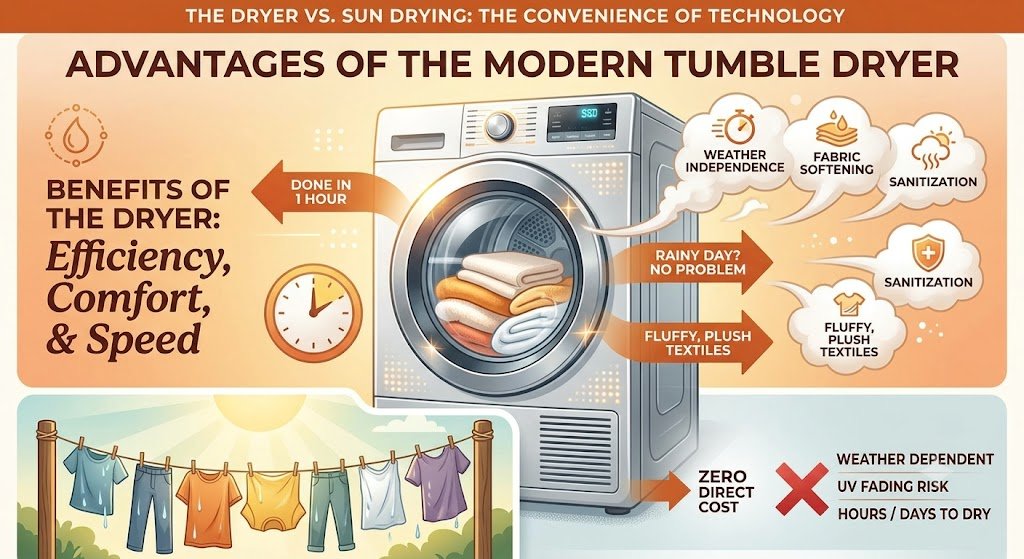
Laundry is one of civilization’s oldest chores, yet the way we finish the job remains a subject of fierce debate. On one side stands conventional sun drying—an ancient, zero-cost, and carbon-neutral practice trusted by households across the world for centuries. On the other side is the modern electric tumble dryer—a marvel of post-war appliance engineering designed to turn damp, heavy textiles into warm, fluffy garments within an hour, regardless of rain, smog, or freezing temperatures.
While modern urban living pushes many households toward automated drying appliances, traditionalists continue to champion the balcony clothesline. Deciding between a tumble dryer and natural sunlight is not merely an aesthetic choice; it impacts monthly utility bills, fabric longevity, indoor air quality, personal health, and your household’s ecological footprint.
1. Mechanics: How Each Method Removes Moisture
To understand the trade-offs of both methods, it helps to examine the underlying physics governing how water leaves wet textiles.
The Physics of Machine Drying
A tumble dryer accelerates evaporation using three interrelated variables: forced heat, mechanical agitation, and airflow.
- Heat Transfer: Modern vented and condenser dryers heat incoming air using electric resistance coils (or gas burners), typically raising drum temperatures between 50°C and 75°C (122°F to 167°F). Modern heat pump dryers use a closed-loop refrigerant cycle to heat air more gently, usually between 40°C and 50°C.
- Mechanical Agitation (Tumbling): As the drum rotates, internal baffles lift clothes and drop them through the stream of heated air. This action separates folds, exposes the maximum surface area of each fiber, and prevents moisture pockets from remaining trapped within layered garments.
- Moisture Evacuation:
- Vented Dryers: Expel moist, warm exhaust air directly outdoors via a duct.
- Condenser Dryers: Pass moist air through a heat exchanger where moisture condenses into liquid water (collected in a tank or drained away), recycling the air.
- Heat Pump Dryers: Condense moisture and reclaim the latent heat to warm the next cycle, running at significantly higher thermodynamic efficiency.
The Physics of Natural Sun Drying
Sun drying relies on ambient atmospheric conditions: solar radiation, relative humidity, and air convection (wind).
- Direct Solar Radiation: Photons from solar rays penetrate outer fabric layers, directly warming water molecules trapped inside cellulose and synthetic lattices. This raises the vapor pressure of the water relative to the surrounding air.
- Vapor Deficit and Relative Humidity: Water naturally evaporates when the air surrounding the fabric is unsaturated. The lower the ambient relative humidity, the faster moisture diffuses into the atmosphere.
- Convective Boundary Layer Disruption: As water evaporates from wet cloth, it forms a thin layer of high-humidity air over the garment’s surface. Wind strips this boundary layer away, continuously replacing saturated air with drier air to maintain the evaporation rate.
2. Comprehensive Comparison Breakdown
| Evaluation Metric | Machine Tumble Dryer | Conventional Sun Drying |
| Cycle Duration | 40 to 90 minutes (predictable) | 2 to 12+ hours (weather-dependent) |
| Energy Consumption | 1.5 to 5.0 kWh per full load | 0.0 kWh (100% passive solar/wind) |
| Direct Operating Cost | Moderate to high (electricity bills) | Zero direct financial cost |
| Weather Dependency | Completely weatherproof | Bound by rain, clouds, cold, and humidity |
| Fiber Stress & Wear | High (friction, lint shed, thermal stress) | Very low (passive hanging, fiber stability) |
| Hygiene & Pathogens | Thermal eradication (dust mites, bedbugs) | Photolytic sanitation (UV-A and UV-B) |
| Color Preservation | High (when run on low/medium heat) | Low (photodegradation and solar bleaching) |
| White Fabrics | Requires optical brighteners/bleach | Naturally brightened via solar oxidation |
| Fabric Hand-Feel | Soft, lofty, plush (open fiber pile) | Crisp, stiff (hydrogen bonding set) |
| Space Footprint | Compact floor area (stacked or freestanding) | Requires expansive lines, balconies, or racks |
| Labor Requirement | Low (transfer from washer to drum) | High (individual pinning, unpinning, sorting) |
3. Fabric Longevity and Structural Wear
One of the most consequential differences between these methods is their effect on the structural integrity of your wardrobe.
+-----------------------------------------------------------------------+
|                       HOW TEXTILES DEGRADE                            |
+-----------------------------------------------------------------------+
|  TUMBLE DRYER                         SUN DRYING                      |
|  * High heat shrinks natural fibers   * UV breaks chemical bonds      |
|  * Mechanical friction creates lint   * Dyes fade over time           |
|  * High heat snaps elastane/spandex   * Minimal fiber friction        |
+-----------------------------------------------------------------------+
The Tumble Dryer’s Impact on Fibers
Every time you clean out the lint trap of a tumble dryer, you are looking at small pieces of your clothes.
- Mechanical Abrasion: As wet textiles rub vigorously against each other and the drum’s metal walls, surface microfibrils snap. Studies on textile degradation demonstrate that mechanical action causes significantly more fiber loss than washing cycles alone. Over 30 to 40 drying cycles, natural cotton garments lose measurable tensile strength and structural thickness.
- Thermal Shock and Shrinkage: Natural fibers like cotton, wool, and linen undergo irreversible mechanical shrinkage when subjected to sudden, intense heat. Heat relaxes the tension introduced during yarn spinning and weaving, causing loops in knitwear to contract tightly.
- Elastane and Synthetic Breakdown: Modern activewear, denim blends, and undergarments rely heavily on polyurethane-based fibers (Spandex, Elastane, Lycra). Repeated exposure to drum temperatures exceeding 55°C breaks down the molecular cross-links within these polymers. This causes elasticity loss, resulting in sagging waistbands, rippled fabric edges, and “blown-out” athletic wear.
Sun Drying’s Impact on Fibers
Hanging laundry on a clothesline is largely static, eliminating mechanical friction entirely. However, sunlight introduces its own form of chemical stress:
- Zero Mechanical Wear: Because garments hang motionless (aside from gentle wind movement), surface fibers do not snap or shed. Your clothes produce negligible lint, preserving original fabric weight and weave tightness for years.
- Preservation of Synthetic Elasticity: Without high chamber temperatures, synthetic elastic bands and stretch fabrics retain their spring and hold their shape far longer.
- Photodegradation (UV Damage): Solar ultraviolet radiation carries sufficient energy to break chemical bonds within organic compounds. Extended exposure to harsh midday sun weakens delicate natural fibers—particularly silk and fine wool—causing them to become brittle over time.
- Color Fading: Sunlight acts as a relentless, free-radical photo-oxidizer. Vibrantly dyed garments, dark cottons, and deep blacks will slowly lose their saturation if left baking under direct sunlight across consecutive weeks.
4. Sanitation, Hygiene, and Health
Hygiene extends beyond merely removing surface dirt in the wash. How laundry dries determines whether it stays clean or becomes a breeding ground for biological contaminants.
Sanitizing with Tumble Dryers
Dryers provide consistent thermal disinfection:
- Eradication of Microscopic Pests: The domestic dust mite (Dermatophagoides pteronyssinus) and bedbugs (Cimex lectularius) along with their eggs are reliably killed by exposure to temperatures above 55°C–60°C for at least 20 to 30 minutes. An electric tumble dryer cycle provides standard, certified eradication for bedding, pillows, and soft toys.
- Bacterial and Fungal Inactivation: Pathogenic bacteria like Staphylococcus aureus and common fungal spores struggle to survive the hot, dry air inside a commercial or domestic dryer drum.
- Zero Outdoor Contamination: For people suffering from seasonal allergies (allergic rhinitis or asthma), machine drying is an effective preventive measure. Line-dried clothes act as electrostatic filters, collecting outdoor tree, weed, and grass pollen, particulate matter (PM2.5), and urban vehicle exhaust. A closed tumble dryer keeps freshly washed clothing free from external environmental irritants.
Sanitizing with Sunlight
Conventional sun drying provides a distinct, highly effective biological cleaning mechanism powered by natural solar radiation:
- UV Photolytic Disinfection: Sunlight contains ultraviolet radiation (specifically UV-A and portions of the UV-B spectrum). UV radiation penetrates bacterial cell walls, disrupting their cellular DNA and RNA, which prevents micro-organisms from replicating.
- Solar Oxidation and Bleaching: Direct exposure to solar photons interacts with atmospheric moisture and oxygen to generate trace amounts of hydrogen peroxide and hydroxyl free radicals on fabric surfaces. This natural photochemical process bleaches out organic stains (such as carotenoids from tomato or mustard spills, berry juice, and infant stains) without chemical chlorine additives.
- Elimination of Damp Odors: Musty smells on wet clothes are primarily produced by volatile organic compounds (VOCs) released by bacteria like Moraxella osloensis. Direct sunlight combined with open airflow dries fabrics quickly enough to halt bacterial proliferation, leaving behind that classic “sun-dried” smell.
5. Sensory Differences: Stiffness vs. Softness
One of the most noticeable differences between these drying methods is how fabrics feel against your skin.
Hanging on Line: Water evaporates slowly -> Hydrogen bonds form -> Fibers lock stiff
Tumbling in Dryer: Drum rotates constantly -> Fibers remain separated -> Plush & soft
The Science of “Line-Dried Stiffness”
When cotton towels or heavy denims dry while hanging motionless on a clothesline, they often feel stiff and cardboard-like. This is caused by hydrogen bonding:
Cotton is composed of cellulose chains rich in hydroxyl (-OH) groups. When cotton is wet, water molecules push between these cellulose chains, breaking their direct bonds. As water evaporates passively from a stationary towel, the adjacent cellulose microfibrils draw closer together. Capillary action creates hydrogen bonds directly between the cellulose chains, locking the fibers into rigid, fixed positions.
To restore softness to line-dried textiles without an appliance, you can:
- Add a splash of distilled white vinegar to the final rinse cycle to strip alkaline detergent residue.
- Shake garments vigorously before hanging and again after taking them down to disrupt surface hydrogen bonds.
- Hang items on breezy days rather than completely still ones.
The Science of “Tumble-Dried Softness”
Tumble dryers produce exceptionally soft, plush towels and clothing through continuous mechanical disruption. Because the fabric is in constant motion while moisture leaves, cellulose microfibrils never sit still long enough to form cross-linking hydrogen bonds.
Additionally, internal airflow fluffs the fabric pile upright. For high-pile fabrics like terrycloth towels, fleece jackets, down duvets, and flannel sheets, tumble dryers produce a loft and tactile softness that static sun drying cannot match without chemical fabric softeners.
6. Financial Costs and Energy Consumption
Evaluating the economics of laundry requires looking at both immediate utility bills and longer-term appliance lifecycles.
Cost Analysis: Tumble Dryers
Tumble dryers rank among the most energy-intensive household appliances, trailing only home heating, ventilation, and air conditioning (HVAC) systems and water heaters in typical domestic energy footprints.
- Vented/Condenser Energy Use: A standard 7kg to 8kg vented electric dryer consumes roughly 3.0 to 4.5 kWh per full cycle. An older condenser unit averages around 3.5 to 5.0 kWh.
- Heat Pump Efficiency: Modern heat pump dryers use closed-loop refrigeration, slashing consumption down to 1.2 to 2.0 kWh per cycle—a dramatic 50% to 65% efficiency gain over traditional heating elements, though balanced by a higher initial retail purchase price.
- Operating Cost Scenarios: Running a 3.5 kWh vented dryer five times per week adds up to 17.5 kWh per week, or roughly 910 kWh annually. At average residential electricity rates, running an older electric tumble dryer can add a noticeable ongoing charge to yearly utility expenses.
- Hidden Costs: Tumble dryers require dedicated physical square footage, regular lint maintenance, duct cleaning (a failure to clear lint-clogged vents remains a leading cause of residential utility fires worldwide), and eventual mechanical repairs for belts, heating coils, and drive motors.
Cost Analysis: Sun Drying
Sun drying costs nothing to operate:
- Energy Use: 0.00 kWh.
- Equipment Capital Cost: A heavy-duty, stainless-steel collapsible floor rack, wall-mounted accordion drying rack, or outdoor clothesline paired with wooden pegs costs very little and can last for decades.
- Long-Term Clothing Preservation: Because garments are spared high-heat stress and drum friction, wardrobes last noticeably longer. T-shirt collars avoid distortion, elastic waistbands stay springy, and seams remain intact, saving money on replacement clothing over time.
7. Environmental Impact: The Carbon Calculation
Household sustainability depends heavily on decarbonizing everyday domestic routines.
+-----------------------------------------------------------------------+
|                     ESTIMATED ANNUAL CO2 FOOTPRINT                    |
|             (Based on ~250 loads/year at average grid intensity)      |
+-----------------------------------------------------------------------+
|  Standard Electric Dryer:   ~400 - 650 kg CO2e / year                 |
|  Heat Pump Dryer:           ~150 - 250 kg CO2e / year                 |
|  Outdoor Sun Drying:          0.00 kg CO2e / year                     |
+-----------------------------------------------------------------------+
A standard electric dryer running 200 to 250 cycles a year accounts for roughly 400 to 650 kilograms of carbon dioxide equivalent (CO2e) annually on a typical fossil-fuel-reliant electricity grid. Over the typical ten-year lifespan of an appliance, a single tumble dryer can generate upwards of 4 to 6 metric tons of greenhouse gas emissions.
Opting for outdoor lines or indoor drying racks eliminates this impact entirely. For households working to lower their personal carbon footprints, moving away from automatic tumble drying is one of the most effective lifestyle adjustments available—requiring no complex home renovations or carbon offsets.
8. Space, Climate, and Urban Living Constraints
Despite the environmental and financial benefits of sun drying, practical modern living conditions often limit its everyday use.
The Urban Reality
- Balcony Restrictions and Aesthetics: Modern apartment complexes often enforce strict homeowners’ association (HOA) rules or building codes that ban hanging laundry from balconies, railings, or exterior windows to preserve building aesthetics.
- Square Footage Pressures: In compact urban apartments, indoor clothes racks take up valuable living space, create visual clutter, and can introduce excess moisture into living areas.
- Indoor Humidity and Mold Hazards: Drying a full 7kg load of wet laundry indoors without direct sunlight or proper ventilation releases approximately two to three liters of water vapor into the living space. In poorly ventilated homes, this spike in relative humidity encourages toxic mold growth (Aspergillus fumigatus), dust mite blooms, and musty odors trapped in carpets and upholstery.
Weather and Seasonal Volatility
- The Monsoon and Winter Dilemma: During extended rainy seasons, humid monsoons, or sub-zero winter months, ambient relative humidity approaches saturation. Under these conditions, clothes hung outdoors can take 24 to 48 hours to dry, often developing sour odors from slow-growing bacterial blooms before drying completes.
- Airborne Pollution: In densely populated cities dealing with dust, industrial pollution, or seasonal agricultural smog, drying white linens or baby clothes outside can expose them to falling soot, road dust, and fine particulate matter.
9. The Hybrid Strategy: How to Get the Best of Both Worlds
Rather than treating these two methods as mutually exclusive, an efficient laundry system pairs each approach with the fabrics and weather conditions that suit it best.
                           SORTING STRATEGY
                                  │
         ┌────────────────────────┴────────────────────────┐
         ▼                                                 ▼
   TUMBLE DRYER                                       SUN DRYING
   • Towels & Terrycloth (Plushness)                  • Dark & Black Cottons (Prevent Fading)
   • Heavy Bed Linens & Duvets                        • Delicates, Silks, Woolens (No Heat)
   • Emergency/Work Uniforms                          • Spandex, Activewear, Yoga Pants
   • Rainy / Freezing Days                            • White Linens (Solar Bleaching)
- Dry Whites in the Sun, Colors in the Shade: Hang white bedsheets, light-colored cottons, and stained kitchen towels in direct, bright sunlight to leverage natural UV bleaching. Turn dark t-shirts, black jeans, and printed fabrics inside out and hang them in indirect shade or breezy, covered areas to prevent color fading.
- Protect Activewear and Delicates from Heat: Keep sports bras, running tights, cycling jerseys, wool knits, and silk blouses completely away from the tumble dryer. Passive air drying preserves elastane stretch, prevents seam unravelling, and stops delicate animal fibers from shrinking.
- Use the Dryer for Bulky Cotton Items: Use the tumble dryer for heavy bath towels, bathrobes, floor mats, and bed linens. This prevents bulky items from taking up drying racks for days, prevents indoor mold buildup, and delivers soft, fluffy towels.
- The “Flash-Fluff” Finishing Technique: If you prefer the energy savings of line drying but dislike the stiff feel of line-dried towels, use a combined approach: line-dry towels until they are 90% to 95% dry, then place them in the tumble dryer on an ambient (air-fluff) or low-heat cycle for five to eight minutes. This breaks up hydrogen bonds, aligns the cotton pile, and delivers fluffy towels with minimal energy use.
- Optimize Dryer Performance When You Use It:
- Always clean the lint screen before every cycle to maximize airflow.
- Run the washing machine’s highest spin speed (1200–1400 RPM) during the wash cycle to extract excess water mechanically before drying starts.
- Add clean, dry wool dryer balls to the drum to bounce between items, separate wet folds, and cut total drying time by up to 20%.
Final Verdict: Which Method Wins?
Neither drying method holds an absolute advantage across all situations; the right choice depends on your daily schedule, wardrobe, living space, and environmental priorities.
The Conventional Clothesline is the winner for:
- Long-term fabric care, protecting delicate clothes, and keeping stretch wear springy.
- Eliminating utility costs and running a zero-emissions household.
- Brightening white linens and naturally removing odors without synthetic perfumes.
The Modern Tumble Dryer is the winner for:
- Busy households, large families, and unpredictable weather conditions.
- Allergen defense, eliminating outdoor pollen, dust, and microscopic pests.
- Delivering soft, plush towels and bed sheets in under an hour.
By using both methods thoughtfully—relying on natural solar drying as your primary default while using an efficient tumble dryer for heavy linens, sanitization, and bad weather—you can protect your clothing, manage your energy bills, and keep laundry day completely stress-free.